
What is BIN sponsorship, and when do you need it?
Every card programme has to answer one question before anything else: whose BIN are you issuing on? The answer determines your launch timeline, your scheme obligations and, often, whether the programme happens at all.
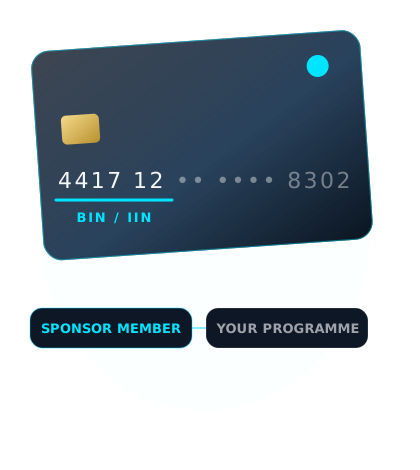
Start with the BIN
A Bank Identification Number, now more formally an Issuer Identification Number, is the leading digits of a card number. When a cardholder taps at a terminal, the network reads those digits and knows which issuer to route the authorisation to. Behind the BIN sits the programme configuration: the product type, the currency, the country, the rules that govern what that card can and cannot do.
BINs are allocated by the card schemes to their principal members. Principal membership is not a form you fill in. It requires a licence, capital, scheme certification, settlement arrangements and ongoing compliance with scheme rules. That is the barrier BIN sponsorship exists to solve.
What sponsorship actually is
In a sponsorship arrangement, a licensed principal member of the scheme lets another party issue cards under the sponsor's BIN and membership. The sponsor stays accountable to the scheme for the programme's conduct, settlement and compliance. The sponsored party builds and runs the customer-facing product.
The sponsor is taking on real risk, which is why sponsorship is not casually granted. Expect due diligence on your financials, your compliance programme, your AML policy, your target market and your projected volumes. A sponsor is effectively lending you their scheme standing, and they will want to be confident you will not damage it.
The three routes
| Own BIN | Sponsored BIN | Platform-managed BIN | |
|---|---|---|---|
| Who holds scheme membership | You | The sponsor bank | The platform provider or its partner |
| Who is accountable to the scheme | You | The sponsor | The provider |
| Time before first card | Longest | Medium | Shortest |
| Certification burden on you | Full | Partial | Minimal |
| Control over programme config | Highest | Shared with sponsor | Within provider parameters |
| Ongoing scheme fees | Direct | Via sponsor | Bundled into platform pricing |
| Typical fit | Established issuers scaling an existing estate | Fintechs with volume and a banking partner | First programmes, pilots, speed to market |
How to choose
The honest decision rule is about what you are optimising for. If you are optimising for speed to a live card, a platform-managed BIN wins, because the scheme certification work is already done and is not sitting on your critical path. If you are optimising for long-run unit economics at scale and you already have the licence and the treasury function to support it, your own BIN wins, because you stop paying somebody else for standing you could hold yourself.
The trap is choosing your own BIN because it sounds more serious, then discovering that certification, settlement arrangements and scheme onboarding have added several quarters before you can test whether customers even want the product. Prove demand on a managed BIN; migrate later if the volume justifies it. Migration is a project, but it is a project you undertake with revenue rather than instead of it.
What sponsorship does not remove
Sponsorship covers scheme membership and BIN access. It does not remove your own regulatory obligations. If you are onboarding customers, you still need the permissions to do so in your jurisdiction, and you still own KYC, AML, sanctions screening and suspicious activity reporting under your own programme. A sponsor will insist on this, because their scheme standing depends on it.
It also does not remove the need for the rest of the stack: processing, personalisation, fulfilment, dispute handling and lifecycle support. A BIN is permission to issue, not the ability to.
Frequently asked questions
What is a BIN?+
A Bank Identification Number is the leading digits of a card number that identify the issuing institution to the card scheme. It tells the network which issuer to route an authorisation to, and it carries the programme configuration behind it.
What is BIN sponsorship?+
BIN sponsorship is an arrangement where a licensed principal member of a card scheme allows another party to issue cards under the sponsor's BIN and scheme membership. The sponsor remains accountable to the scheme; the sponsored party runs the customer-facing programme.
Do I need my own BIN to launch a card programme?+
No. Most first programmes launch on a sponsor's or a platform provider's managed BIN ranges, because securing your own BIN and completing scheme certification adds significant time before a single card exists. Institutions with an existing issuing estate often prefer their own BIN.
How long does it take to get your own BIN?+
It varies by scheme, jurisdiction and the applicant's existing membership status, but it is measured in months rather than weeks, and it is gated by scheme certification rather than by paperwork alone. Launching on a managed BIN removes that from the critical path.
Launching on a managed BIN
Zen Card programmes can run on managed BIN ranges so scheme certification is not on your critical path, or on your own BIN if you hold one.